
A real-world deployment we're proud to be part of.
Drive through any growing city and you'll pass them without a second thought: the poles at the intersection, the cameras looking down at the lanes, the gray enclosure bolted halfway up the mast. What used to be a passive camera mount is quietly becoming one of the most important pieces of municipal infrastructure, a place where decisions about traffic, safety, and city life are now made in real time.
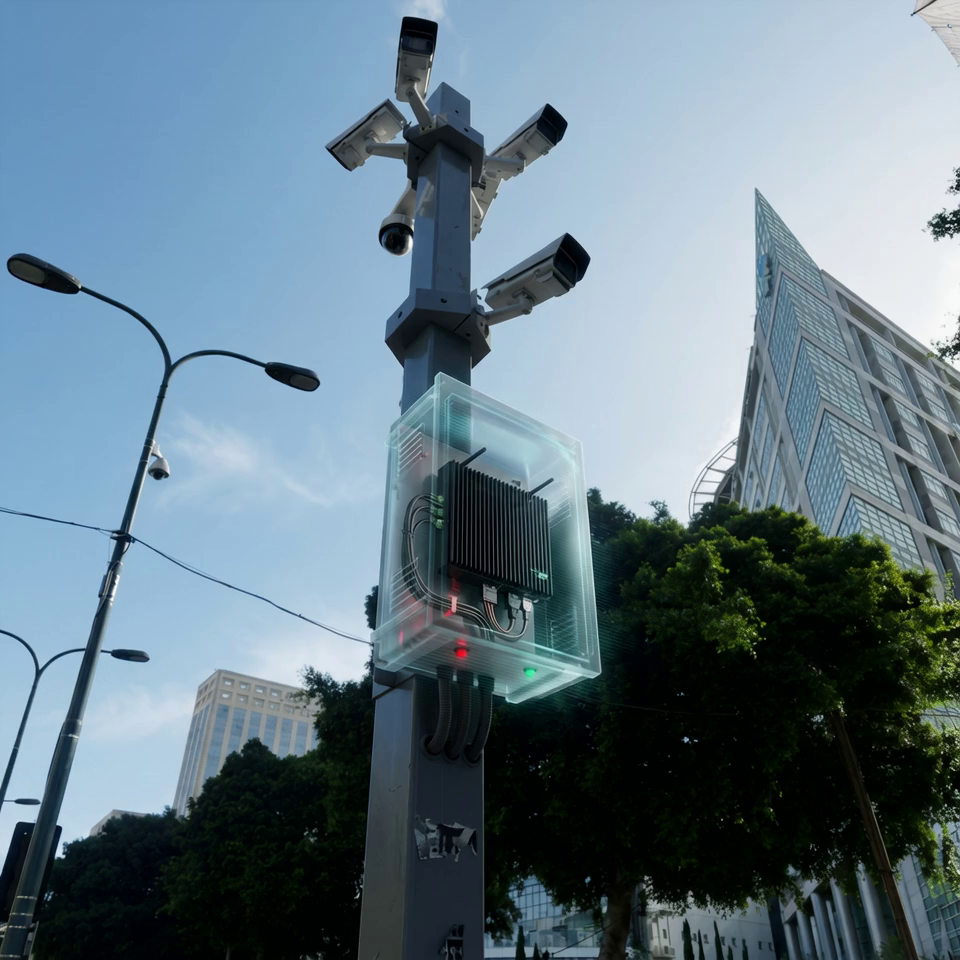
We recently took part in a deployment that captures this shift perfectly. At a busy urban intersection, a single pole carries multiple cameras at the top and a compact, sealed enclosure below. Inside that enclosure sits the brain of the whole installation: a Tensor-I22 fanless edge computer. The cameras see; the Tensor-I22 thinks. And it does its thinking right there at the roadside, not in a server room on the other side of the city.
This is what edge computing for traffic control and municipal governance actually looks like, and it's why we want to walk through why the hardware choice matters so much.
Why traffic intelligence belongs at the edge
For years the default architecture was simple: put cameras on the street and stream everything back to a central data center for processing. It works, until it doesn't. Streaming dozens of high-resolution video feeds across a city consumes enormous bandwidth and recurring connectivity costs. Round-tripping every frame to the cloud adds latency that is unacceptable when you're trying to react to a stalled vehicle, a wrong-way driver, or a pedestrian stepping off the curb. And piping raw footage of citizens to a remote server raises real privacy and compliance questions.
Edge computing flips the model. By processing video where it's captured, the system analyzes each frame on the spot, sends only structured insights, vehicle counts, queue lengths, incident alerts, anonymized metadata - back to the traffic management center, and keeps raw imagery local. The result is lower bandwidth, faster reactions, stronger privacy, and a system that keeps working even if the backhaul link drops.
But the edge is a hostile place to put a computer. A roadside enclosure bakes in summer, freezes in winter, vibrates with passing trucks, collects dust and moisture, and may never be opened again for years. This is exactly the gap the Tensor-I22 was built to fill.
Built for the roadside, not the rack
The Tensor-I22 is a configurable, fanless industrial computer, and almost every line of its specification reads like a checklist for outdoor municipal deployment.
Fanless, sealed, and rugged. The Tensor-I22 cools itself by convection through an all-metal aluminium and zinc die-cast housing with no vents and no fans. That single design choice removes the most common point of failure in roadside equipment. There is no fan to seize, no vent to clog with dust and exhaust, and no moving part to wear out. It is rated across an industrial temperature range of -40°C to 70°C and 5–95% non-condensing humidity, so the same unit can be deployed in a desert intersection or a freezing northern junction without modification.
Power for the cameras, built in. The deployment in our video pairs the box with the cameras on the same pole and the Tensor-I22 can power those cameras directly. With its optional PoE Gigabit LAN ports, the edge computer delivers both data and power over a single cable to each camera, cutting installation complexity and cabinet clutter. Add up to four Gigabit Ethernet ports in total, and a single unit comfortably handles several camera streams plus an uplink.
Backhaul that reaches the control center. Intersections are often far from the nearest network closet. Optional SFP+ ports for optical LAN let the Tensor-I22 connect over fiber across long distances to a central traffic management system, while M.2 slots support Wi-Fi 6E and 4G/5G cellular for sites where running fiber isn't practical. The system stays connected however the city's infrastructure is laid out.
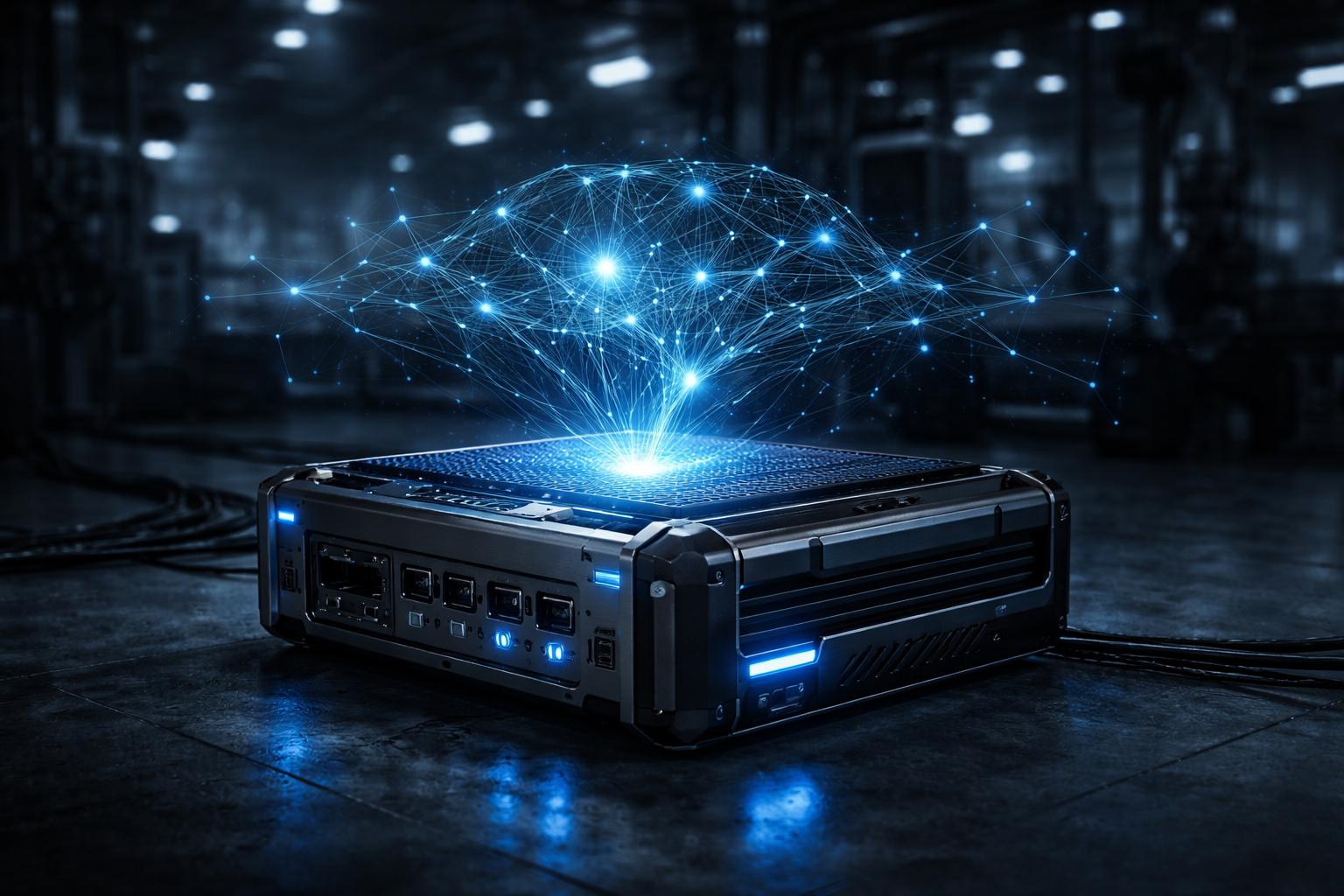
Real AI, on the pole. This is where traffic control becomes traffic intelligence. The Tensor-I22 is powered by Intel's 11th Gen Core processors (Tiger Lake UP3) with integrated Iris Xe graphics, and it can be equipped with up to two optional Hailo-8 AI accelerator modules. That turns the box into a genuine computer-vision engine capable of running deep-learning models on live video at the edge detecting and classifying vehicles, counting traffic by lane, reading license plates for enforcement or access control, spotting pedestrians and cyclists, measuring queue lengths, and flagging incidents the moment they happen.
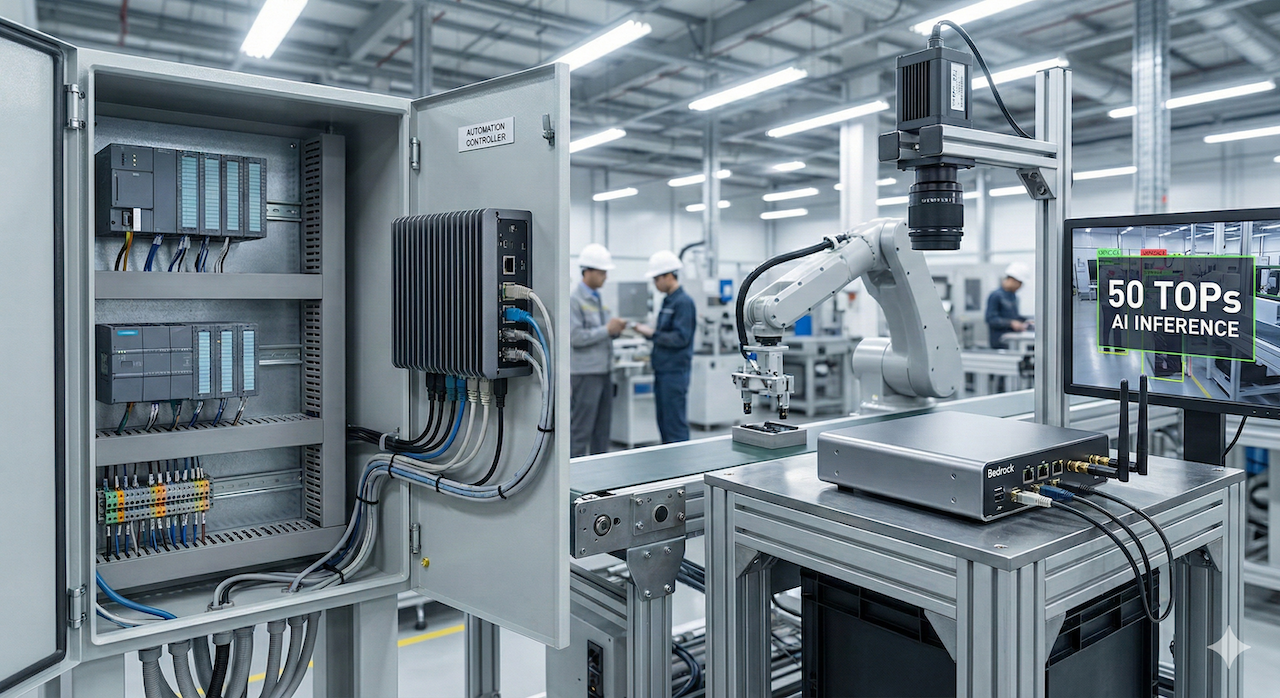
Talks to the existing street furniture. A traffic deployment is never just cameras. The Tensor-I22 offers up to 20 RS-232/RS-485 serial ports, CAN bus, and isolated GPIO the industrial interfaces needed to connect directly to signal controllers, inductive loop detectors, variable message signs, barriers, and environmental sensors. The same unit that analyzes the video can also act on it.
Flexible, resilient power. With a wide 12–56V DC input, the Tensor-I22 adapts to whatever a roadside cabinet provides, including battery backup or solar arrays for off-grid installations. Combined with a footprint of just 200 × 200 × 35.3 mm at 420 grams and VESA or DIN-rail mounting, it slips into the kind of compact enclosure you see clamped to the pole in the video.
Secure and remotely manageable. Unattended roadside assets need to be locked down and serviced without a truck roll. A Trusted Platform Module (TPM), Intel vPro on the i5/i7 models, Wake-on-LAN, and a remote power button let city IT teams secure, monitor, and recover units remotely keeping maintenance costs and downtime low across an entire fleet of intersections.
What this unlocks for cities
Put all of that together at every intersection and the municipal payoff is substantial:
Adaptive signal control. Instead of fixed timers, signals respond to real demand - shortening queues, smoothing flow, and cutting the idling that drives both frustration and emissions.
Faster incident response. Stalled vehicles, collisions, wrong-way drivers, and congestion are detected and reported in seconds, so operators and emergency services can act immediately.
Safer streets. On-device vision can prioritize pedestrians and cyclists, monitor crosswalks, and identify near-miss hotspots that inform long-term road-safety planning.
Smarter enforcement and access. License-plate recognition supports enforcement, tolling, restricted-zone access, and parking management all processed locally.
Privacy by design. Because analysis happens on the pole and only metadata leaves the site, cities can deliver these services while keeping raw video local and citizens' data protected.
Lower total cost. Less bandwidth, fewer central servers, and near-zero-maintenance fanless hardware mean a deployment that scales intersection by intersection without runaway operating costs.
Our role
Edge AI for cities only works when the hardware is matched precisely to the environment and the application. That's what we do at Peila: we architect rugged, fanless computing platforms for the edge and configure them- processor, storage, networking, AI acceleration, I/O, and enclosure, for the exact job in front of them. The intersection in this project is one example of that work, and seeing a Tensor-I22 quietly running the show at a real city junction is exactly why we love building for the edge.
If your municipality, integrator, or smart-city project is looking at traffic control, surveillance, or intelligent transportation, we'd be glad to help you spec the right platform.
Talk to us → | Explore the Tensor-I22 →
Peila Ltd architects rugged, fanless PCs tailored for the edge | driving ideas from concept to reality. Learn more at peila-international.com.
.png)



.png)


.png)


